
A residential treatment vs PHP schedule changes the entire rhythm of a client’s day
Residential mental health programs provide 24/7 live-in supervision for 30, 60, or 90 days, treating conditions like major depressive disorder with round-the-clock clinical support. Partial hospitalization programs (PHP) offer high-intensity outpatient care, letting clients return home nightly. Terra Behavioral Health structures both levels around symptom severity, safety needs, and clinical dimensions defined by ASAM criteria.
What is residential vs partial hospitalization?
Residential treatment requires clients to live full-time at a facility, receiving 24/7 medical and clinical supervision in a structured environment. Partial hospitalization (PHP) operates as a day-treatment program where clients attend intensive therapy sessions during the day and return home each evening. The core difference comes down to overnight stays and the level of daily structure each program provides.
How do the daily schedules differ?
A residential treatment vs PHP schedule changes the entire rhythm of a client’s day. In residential care, clients remain on-site around the clock. The program removes them from outside triggers, creating a safe, substance-free environment where they focus entirely on healing. Meals, therapy groups, individual sessions, and evening activities all happen within the facility.
A PHP level of care offers a different structure. Clients arrive in the morning, participate in several hours of intensive therapy, and leave in the afternoon. This day treatment program mental health model allows clients to practice new coping skills in real-world settings each evening while still receiving daily clinical support.
Which conditions does each level treat?
Terra Behavioral Health provides detox, residential, PHP, IOP, and virtual care for adults with complex mental health and substance use conditions. The choice between residential vs partial hospitalization depends on symptom severity and safety needs.
The ASAM levels help guide care choices; consult with Terra for detailed explanations. Residential care (ASAM 3.5) provides around-the-clock structure for clients who cannot safely manage themselves outside a controlled setting. PHP (ASAM 2.5) suits clients who need daily intensive treatment. Have a stable enough home environment to return to each night.
What is the step-down logic?
Mental health levels of care follow a step-down progression. Clients often move from residential treatment to PHP as symptoms stabilize. This gradual reduction in structure prevents relapse by maintaining therapeutic momentum while increasing real-world responsibility. A client who completes residential care transitions to PHP, then to intensive outpatient (IOP), and finally to outpatient therapy. Each step tests readiness for less supervision while keeping clinical support accessible.
How do mental health levels of care differ?
Mental health levels of care form a structured spectrum from least to most intensive, matched to symptom severity and individual needs. Choosing the right level depends on the severity of the person’s symptoms, their insurance coverage, and whether they live in an urban or rural setting, according to the Family and Caregiver Training and Support Program. At the highest intensity end, residential treatment vs PHP represents the key distinction for clients needing 24/7 structure versus daily therapeutic programming with nightly independence.
What defines the most intensive mental health levels of care?
Mental health levels of care range from inpatient hospitalization through outpatient services, each designed for a specific acuity threshold. Residential treatment vs PHP sits at the middle-to-upper end of this spectrum. Residential programs provide live-in facilities where people receive care for mental health disorders, with stays varying based on individual needs. Day treatment program mental health services, also called PHP level of care, offer comparable therapeutic intensity, often five to seven hours of daily programming, without overnight stays.
What conditions do residential programs commonly treat?
Residential programs commonly treat major depressive disorder, generalized anxiety disorder, bipolar disorder, post-traumatic stress disorder (PTSD), obsessive-compulsive disorder (OCD), eating disorders, personality disorders, and severe stress-related conditions. This breadth of coverage reflects the high-acuity clientele these programs serve: individuals whose symptoms disrupt daily functioning and require immersive, structured intervention.
How do the ASAM levels clarify the difference?
Clinicians use the ASAM level 3.5 vs 2.5 framework to assign clients correctly. ASAM 3.5 corresponds to residential treatment: medically monitored, 24-hour structured care. ASAM 2.5 represents the PHP level of care, requiring at least 20 hours of clinical service per week but allowing the client to sleep at home. Terra Behavioral Health designs its clinician-led programs across this full continuum (detox, residential, PHP, IOP, and virtual care) so clients transition through mental health levels of care without gaps, supporting long-term recovery and growth rather than one-time treatment.
Residential vs PHP: Which Level of Care Fits Your Needs?
Choosing between residential vs partial hospitalization comes down to one question: does the person need 24-hour supervision, or can they return home each night? Residential treatment vs PHP differ primarily in structure, intensity, and the amount of clinical monitoring provided. Residential care, which aligns with ASAM level 3.5 vs 2.5 distinctions, provides round-the-clock support in a live-in setting. A PHP level of care, by contrast, offers intensive daily treatment without overnight stays. Understanding these mental health levels of care helps families and clinicians match the setting to symptom severity and safety needs.
The Core Difference: 24-Hour Structure vs Daily Treatment
A residential program requires the individual to live at the facility full-time, typically for 30, 60, or 90 days. This setting removes the person from outside triggers and provides 24/7 medical and clinical supervision. A day treatment program mental health option, which is another name for PHP, allows the individual to attend treatment during the day and return home each evening. The PHP level of care suits individuals who have a safe, supportive home environment and do not require overnight monitoring.
ASAM Level 3.5 vs 2.5: Matching Intensity to Need
The American Society of Addiction Medicine (ASAM) defines these levels of care. ASAM level 3.5 vs 2.5 comparisons show that residential treatment (3.5) provides 24-hour structured care. PHP (2.5) offers at least 20 hours of clinical programming per week without overnight supervision. Clinicians use these mental health levels of care to determine the least restrictive setting that still ensures safety. If a person struggles with severe symptoms, active safety concerns, or a chaotic home environment, residential care is the appropriate choice. If the individual is stable enough to manage evenings at home, a PHP level of care offers the necessary support while maintaining community connections.
When Residential Treatment vs PHP Becomes Clear
The decision between residential treatment vs PHP becomes clearer when evaluating daily functioning and risk. Residential care is designed for individuals needing intensive support; contact Terra for specific eligibility criteria. A day treatment program mental health approach works for those who have completed residential treatment and need step-down support. For those whose symptoms are moderate and manageable at home. Families should also consider the individual’s support system: PHP requires a reliable home environment and transportation to and from the facility each day.
Making the Choice with Clinical Guidance
Terra Behavioral Health provides both residential and PHP level of care options, allowing clients to step down gradually as they progress. The clinical team assesses each individual using ASAM criteria to recommend the appropriate mental health levels of care. This structured approach ensures clients receive the right intensity of care at the right time, supporting long-term recovery and growth. Families and referring clinicians should schedule an assessment to determine whether residential structure or the flexibility of a day treatment program mental health setting best meets the individual’s needs.
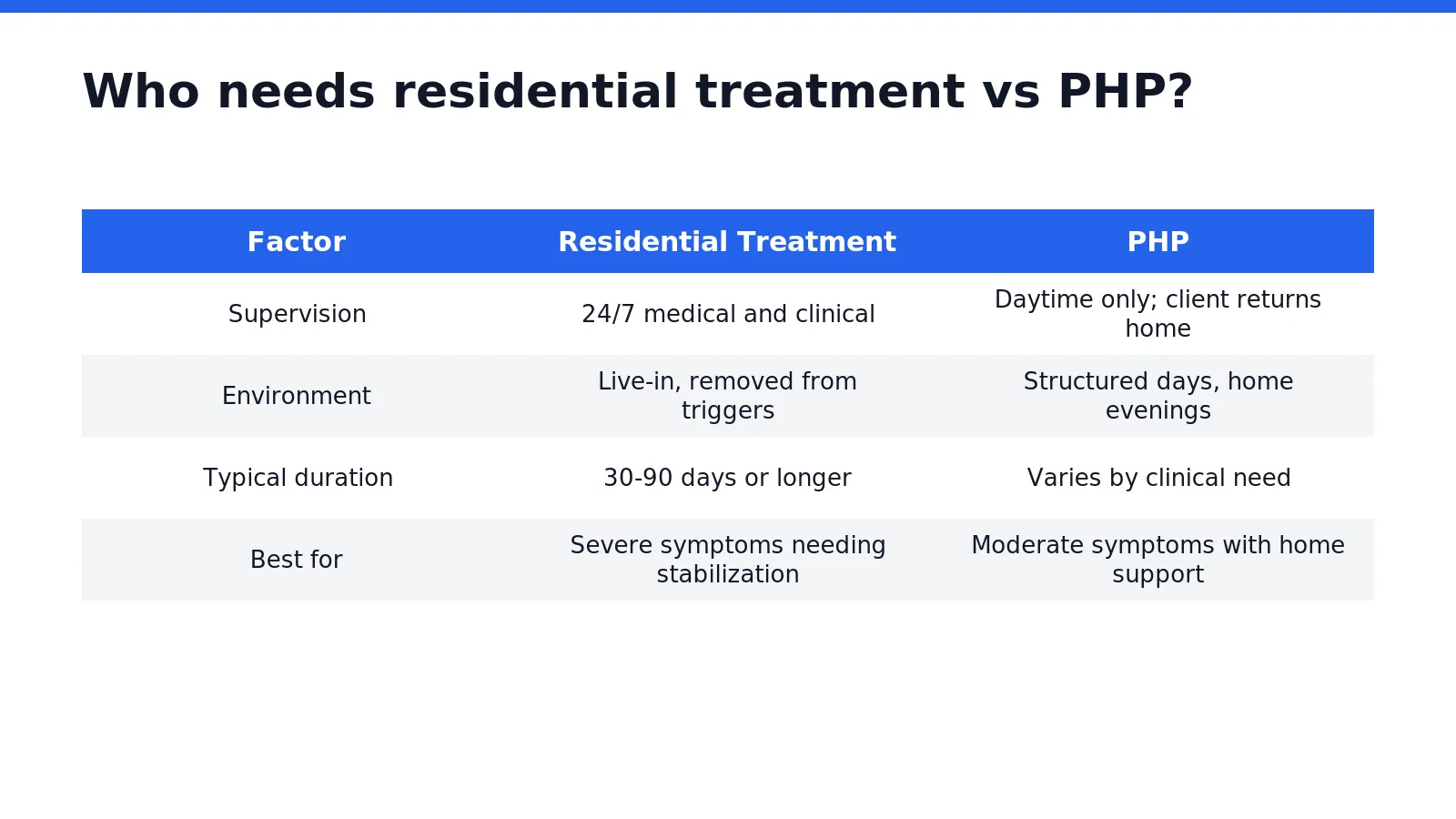
Who needs residential treatment vs PHP?
The choice between residential vs partial hospitalization depends primarily on the severity of a client’s symptoms. Their need for 24/7 supervision versus the ability to return home each evening. Residential treatment vs PHP decisions rest on whether someone requires live-in support for stabilization or can manage structured daytime care without overnight stays.
When does residential treatment make sense?
Residential programs serve clients who need intensive, around-the-clock medical and clinical supervision. These programs remove clients from outside triggers entirely, providing a contained environment for stabilization. The length of stay varies; contact Terra Behavioral Health for more information. Residential care supports long-term emotional healing beyond symptom management alone. It is life-changing for people who need intensive support that a home environment cannot provide.
When is a PHP level of care appropriate?
A PHP level of care delivers intensive psychiatric and therapeutic services without requiring overnight stays. A day treatment program mental health structure like PHP fits clients who need substantial daily structure. Have a safe, stable home environment to return to at night. This option bridges the gap between full residential care and less intensive outpatient services.
The table below compares key differences:
How does the ASAM level 3.5 vs 2.5 distinction guide placement?
ASAM level 3.5 vs 2.5 corresponds directly to residential versus PHP care. Level 3.5 indicates clinically managed, medium-intensity residential treatment with 24-hour nursing availability and 24-hour structured programming. Level 2.5 represents the PHP tier: day programming with at least 20 hours per week of clinical service but no overnight bed. Clinicians use these mental health levels of care to match clients with the right intensity of support based on symptom severity, risk factors, and recovery environment stability.
What does a day treatment program mental health include?
A day treatment program mental health, also called a Partial Hospitalization Program (PHP), provides structured, intensive psychiatric and therapeutic services during the day while clients return home each evening. This PHP level of care bridges the gap between inpatient hospitalization and less intensive outpatient options. The distinction between residential vs partial hospitalization often comes down to overnight supervision: residential care provides 24/7 structured support. PHP offers comparable clinical intensity without overnight stays.
Core components of a day treatment program
Terra Behavioral Health structures its PHP around several clinical elements, each designed to support measurable outcomes:
Individual therapy sessions – one-on-one work with a licensed clinician, typically multiple times per week
Group counseling – daily process and skill-building groups that foster peer connection
Medication management – psychiatric oversight integrated into the treatment plan
Psychoeducation – education about diagnosis, symptom management, and relapse prevention
Daily grounding practices – structured routines that build consistency and attunement
How does PHP differ from residential treatment?
The primary difference lies in structure and supervision. ASAM level 3.5 vs 2.5 captures this contrast: Level 3.5 (residential) requires 24/7 monitoring and a live-in setting. Level 2.5 (PHP) demands at least 20 hours of structured programming weekly without overnight stays. Clients in residential treatment vs PHP make the same clinical progress when the appropriate level matches their acuity. For individuals with stable housing and adequate support systems, a day treatment program mental health removes the disruption of full-time residence while maintaining therapeutic intensity.
Terra’s approach emphasizes relationship quality as the foundation of treatment. Whether a client enters residential or PHP, the clinical team builds consistent, attuned therapeutic alliances. The quiet luxury retreat environment supports focus across all levels of care. The day program allows clients to practice new coping skills in their real-world environments each evening.
What conditions does a PHP treat?
A day treatment program mental health addresses a range of complex conditions including major depressive disorder, generalized anxiety, bipolar disorder, PTSD, and co-occurring substance use disorders. Terra integrates evidence-based therapies such as CBT, DBT, and trauma-focused modalities into the PHP schedule. Family involvement remains a core component, with regular family therapy sessions woven into the treatment plan.
How do you step down from residential to PHP?
Stepping down from residential care to a PHP level of care (Partial Hospitalization Program) marks a critical transition in the recovery journey. A PHP program is a structured, day-treatment level of care that provides intensive psychiatric and therapeutic services without requiring overnight stays. This step-down allows clients to apply the coping skills developed during residential treatment while still receiving daily clinical support.
The transition typically occurs when a client no longer requires 24/7 medical supervision but still needs several hours of structured therapy each day. Most residential treatment programs last 30, 60, or 90 days, with some long-term programs extending beyond that. The exact timing depends on clinical progress, symptom stability, and readiness for increased independence.
What distinguishes residential treatment vs PHP?
How does Terra support the residential to PHP transition?
Terra’s continuum of care integrates psychiatric care, psychotherapy, medication management, and family involvement to support smooth transitions between levels. The care model is designed to support long-term recovery and growth, not just one-time treatment. Clinicians work with each client to identify the right moment for stepping down, ensuring the client has built sufficient coping strategies and a stable support system before moving to the day treatment program mental health setting.
What changes during the ASAM level 3.5 vs 2.5 transition?
The move from residential (ASAM level 3.5) to PHP (ASAM level 2.5) represents a shift in mental health levels of care from 24-hour structured environment to intensive outpatient treatment. Clients gain more autonomy while maintaining daily therapeutic contact. This gradual reduction in structure helps prevent relapse by allowing clients to test their recovery skills in real-world settings while clinical support remains readily available.
How does trauma-informed care apply at each level?
Trauma-informed care at Terra functions as the foundation of treatment delivery across every level of care, not as a standalone modality or marketing label. This approach shapes how clinicians structure residential treatment vs PHP, ensuring that safety and predictability remain constant whether a client stays overnight or attends a day treatment program mental health setting.
The commitment to safety, predictability, and respect appears in both clinical work and organizational practices. Terra prioritizes physical, emotional, and psychological safety at every step. Environments, routines, and interactions are structured to reduce threat, overwhelm, and unpredictability. That structure looks different across the mental health levels of care, but the principle stays identical.
How does the residential setting apply trauma-informed principles?
Residential care offers the highest degree of environmental control. The live-in structure allows staff to manage routines, lighting, noise, and interaction patterns with precision. Clients recovering from acute distress benefit from this predictability because the setting itself reduces sensory and emotional load. Every staff member, from clinicians to support teams, follows the same trauma-informed protocols.
How does the PHP level of care maintain safety?
The PHP level of care applies the same principles in a part-time structure. Clients return home each evening, so the program focuses on building predictable routines that extend beyond facility walls. Clinicians prepare clients for the unpredictability of home environments. This approach recognizes that many individuals entering care have experienced trauma, including developmental, relational, medical, or systemic trauma.
The ASAM level 3.5 vs 2.5 distinction matters here. Residential treatment (level 3.5) provides round-the-clock trauma-informed supervision. The PHP level of care (level 2.5) extends that same philosophy into daily structured programming. Both approaches honor the same core commitment: care that never re-traumatizes, delivered by people who understand that healing requires safety first.
How do you choose the right level of care?
Selecting between residential vs partial hospitalization depends on three factors: symptom severity, insurance coverage, and geographic access. The mental health levels of care form a continuum. The right placement matches clinical need with the least restrictive environment that still ensures safety. Terra Behavioral Health offers personalized, clinically-sound treatment that fosters safe therapeutic alliances, facilitating real progress and healing through connection.
What determines whether residential or PHP is appropriate?
Symptom severity drives the decision. Clients who need 24/7 medical monitoring, struggle to maintain basic self-care, or face acute safety concerns typically require residential care. Those who have stabilized enough to sleep at home but still need daily structured treatment often step into a PHP level of care. Insurance networks also influence the choice, as some plans cover residential stays only after failed outpatient attempts. Geographic access matters too. Rural areas may lack nearby PHP programs, making residential treatment the only viable option even for moderate symptoms.
How does ASAM level 3.5 vs 2.5 guide the decision?
The ASAM level 3.5 vs 2.5 distinction provides clinical clarity. Level 3.5 (residential) involves 24-hour nursing care and structured programming in a live-in setting. Level 2.5 (PHP) requires at least 20 hours of therapeutic services per week. Allows the client to return home each evening. A day treatment program mental health setting, another name for PHP, works best when the home environment supports recovery and the client can manage evenings independently.
Terra was founded by Andie Hollowell and other experienced leaders who recognize the importance of relational, coordinated, and consistent care. Terra’s programs are structured to deliver ethical, regulatory-compliant behavioral health services with a focus on personal and clinical integrity. For families weighing residential treatment vs PHP, the core question remains: does the client need round-the-clock structure, or can daily treatment with evening independence sustain progress?
Conclusion
In closing, choosing between residential and partial hospitalization care comes down to how much structure and support a person needs right now, not a judgment about severity or effort. Both levels share the same foundation: clinician-led treatment, evidence-based therapy, and a commitment to connection over quick fixes. At Terra Behavioral Health, the goal is to meet each person where they are, offering a continuum of care that adapts as healing unfolds, so recovery feels personal, structured, and grounded in genuine therapeutic alliance.